

The hours after an accident are rarely clear. You may be in pain, running on adrenaline, and getting calls from insurance adjusters before you have even seen the full extent of your injuries. That is exactly why knowing how to document accident injuries matters. Good documentation protects your health, preserves evidence, and makes it harder for an insurance company to downplay what happened.
If you wait until symptoms get worse or paperwork starts piling up, important details can disappear. A missed photo, an incomplete medical record, or a gap in treatment can turn into a problem later. Whether you were hurt in a car crash, trucking accident, workplace incident, refinery explosion, or another serious event, the goal is the same – create a clear record from day one.
How to document accident injuries from the start
Start with medical care. If emergency treatment is needed, get it immediately. If you are not taken by ambulance, go to an ER, urgent care clinic, or your doctor as soon as possible. The first medical visit creates a baseline record that connects your injuries to the accident. Without that record, the other side may argue that you were not really hurt or that something else caused your condition.
Be specific when you talk to medical providers. Do not just say you are sore. Explain where the pain is, when it started, whether it radiates, and what activities make it worse. Mention headaches, dizziness, numbness, blurred vision, anxiety, sleep problems, and anything else that appeared after the accident. Injured people often focus on the most obvious pain and leave out symptoms that later become major issues.
Consistency matters. If your shoulder, back, knee, and neck hurt, say so at the beginning and keep reporting those symptoms at follow-up visits. Insurance companies look for inconsistencies. If a symptom appears in your records for the first time weeks later, they may claim it is unrelated.
Photograph injuries before they change
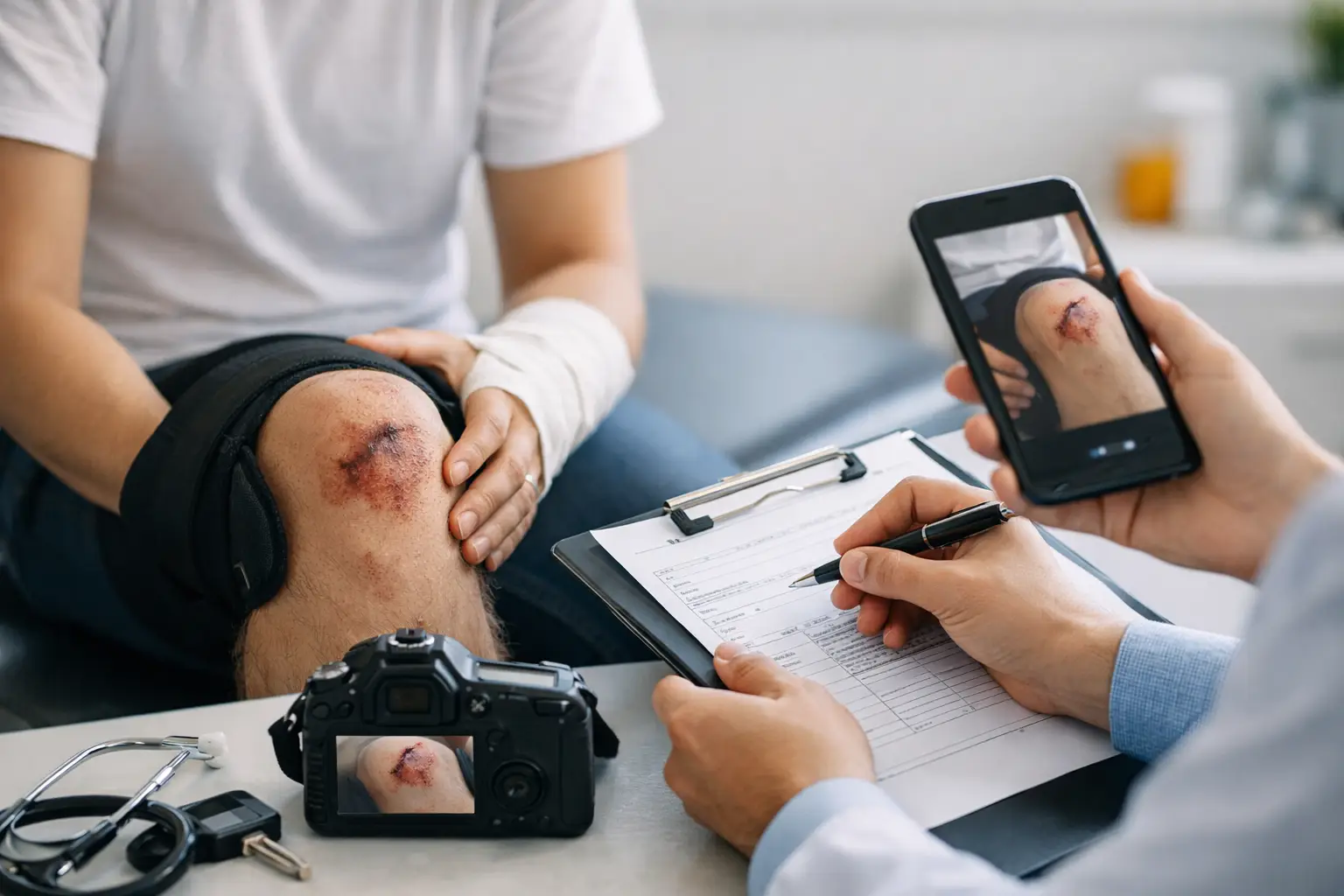
Visible injuries can fade quickly. Bruising changes color. Swelling goes down. Cuts begin to heal. Take photographs as soon as you safely can, then continue taking them over the next several days and weeks.
Use good lighting and photograph the same injury from more than one angle. Take close-up shots and wider images that show where the injury is located on your body. If possible, include a date stamp or preserve the original file metadata on your phone. Do not edit the images beyond basic storage and organization.
If you have medical devices such as a brace, sling, cast, stitches, bandages, or mobility aids, photograph those too. The same goes for scarring as it develops. In serious cases, a sequence of images can show the full progression of the injury far better than a single photo taken weeks later.
Property damage can also support the injury claim. Damage to a vehicle, motorcycle, bicycle, hard hat, safety gear, or damaged work equipment may help show the force of impact. That does not replace medical proof, but it can reinforce your account.
Keep every medical record and bill
One of the most practical parts of how to document accident injuries is simple record keeping. Save every document related to treatment. That includes ambulance records, emergency room records, hospital discharge papers, imaging reports, prescriptions, physical therapy notes, referrals, specialist evaluations, and billing statements.
Do not assume the records will be easy to gather later. Providers merge systems, offices close, and billing departments separate records from treatment files. Create one folder, digital or paper, and keep everything in it.
It also helps to track out-of-pocket costs as they happen. Save receipts for medication, medical equipment, co-pays, parking at appointments, and travel expenses related to treatment. Those losses may seem minor at first, but they add up, especially when recovery takes months.
If you miss work, keep wage records too. Hold onto pay stubs, tax records, attendance reports, and any written note from your employer showing missed time, reduced duties, or lost hours. For many injured people, wage loss is one of the fastest-growing parts of the claim.
Write down symptoms as they happen
Medical charts do not capture everything. A short daily journal can fill in the gaps. This is not about writing pages every night. It is about making a clean, honest record of what the injury is doing to your life.
Write down your pain level, where you hurt, what you could not do that day, and whether your sleep, driving, work, or household tasks were affected. If your injury keeps you from lifting your child, walking up stairs, working a shift, or concentrating through the day, note that. These details help explain the real-world impact of the injury.
Be accurate, not dramatic. Overstating symptoms can hurt your credibility. So can pretending you are fine when you are not. The best journal is factual and consistent.
This becomes especially important with injuries that are harder to measure from a photograph alone, such as soft tissue damage, traumatic brain injuries, chronic pain, or emotional distress after a violent crash or workplace explosion. Those injuries are real, but they often require stronger day-to-day documentation.
Follow treatment and document gaps honestly
Insurance companies often argue that gaps in treatment mean the injury was not serious. Sometimes that is unfair. People miss appointments because they cannot afford care, cannot drive, cannot get time off work, or think they will heal on their own. But if there is a treatment gap, it needs to be explained.
Go to follow-up appointments, attend therapy, take prescribed medication as directed, and follow work restrictions. If you cannot follow through for a legitimate reason, make a note of it and tell your doctor. That explanation may matter later.
There is also a practical reason to stay in treatment. Some injuries do not fully show themselves in the first 24 to 72 hours. Back injuries, concussions, joint damage, and internal complications can worsen over time. Continuing care helps protect both your health and your case.
Be careful with insurance statements and social media
Documentation is not limited to medical files. What you say after the accident matters too. If an adjuster asks for a recorded statement early on, be cautious. People in pain often guess about speed, timing, or how badly they are hurt. Those guesses can be used against them later.
The same goes for social media. A single post, photo, or comment can be taken out of context. A smiling picture at a family event does not prove you are not injured, but insurance companies may still try to use it that way. Until the claim is resolved, keep your online activity limited and private.
You should also avoid casual messages that minimize what happened. Telling someone “I am okay” right after a traumatic event is common and understandable, but those words do not always age well once medical testing reveals the actual damage.
How to document accident injuries when the harm is severe
Serious injury cases need a wider lens. If the accident caused surgery, hospitalization, permanent impairment, burns, disfigurement, neurological symptoms, or long-term disability, your documentation should track not just treatment but life changes.
That may include changes to your job duties, home modifications, ongoing rehabilitation, mental health care, and the effect the injury has on your independence. Family members may also be able to help document what they observe, especially when the injured person is dealing with severe pain, memory problems, or limited mobility.
In industrial and workplace accidents, there may be additional records worth preserving, such as incident reports, OSHA-related documentation, witness names, photographs of the scene, and communication with supervisors. In vehicle crashes, the police report, tow yard photos, and repair estimates can all help provide context. The right evidence depends on the kind of case.
When legal help makes a difference
If the injuries are more than minor, getting legal help early is often the smart move. A lawyer can help preserve evidence, gather records, deal with insurance adjusters, and spot weak points before they become expensive problems. That is especially true in trucking cases, industrial accident claims, wrongful death matters, and any case involving disputed liability or significant medical care.
The Buchanan Law Office, P.C. represents injured people in serious Texas accident cases and understands how quickly evidence can slip away when no one takes control of the process. Even strong claims can be undermined by poor documentation, delayed treatment, or statements made too early.
You do not need a perfect file on day one. You do need to act with purpose. Take the photos, get the treatment, keep the records, and write down what the injury is costing you in daily life. When the time comes to prove your losses, the strongest cases usually are not built on memory – they are built on documentation.









2 Comments