
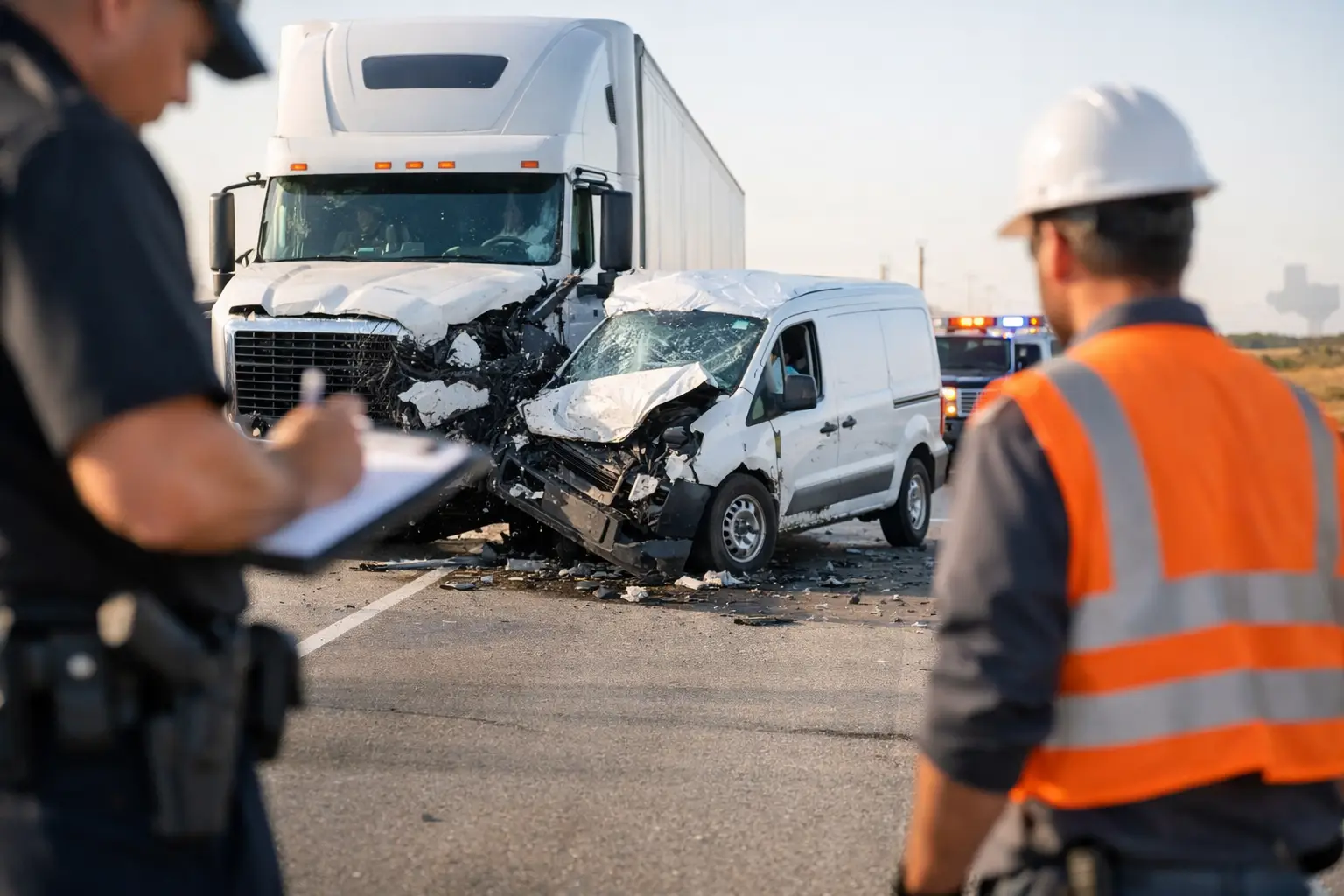

A crash with a company truck, delivery van, work pickup, or 18-wheeler can change the legal picture immediately. Commercial vehicle crash liability often reaches beyond the person behind the wheel. The driver may have made the critical mistake, but an employer, vehicle owner, maintenance contractor, cargo company, or another business may share responsibility for the harm.
That matters because serious injuries bring serious costs: emergency care, surgeries, lost income, future treatment, pain, and a disruption to your family’s life. Texas law allows injured people to pursue compensation from negligent parties. The challenge is identifying every responsible party and preserving the evidence before it disappears.
Why Commercial Vehicle Crashes Are Different
A commercial vehicle is used for business purposes. It may be a tractor-trailer, oilfield truck, construction vehicle, utility truck, rideshare vehicle, delivery van, company-owned pickup, or a car driven by an employee while performing job duties.
These cases are not simply larger car accident claims. Businesses often have insurance carriers, safety departments, lawyers, electronic records, and internal reporting systems working to protect the company’s interests shortly after a collision. In a trucking case, for example, the carrier may dispatch an investigator to inspect the scene and vehicle before an injured driver has even left the hospital.
The company may also control evidence that does not exist in an ordinary passenger-car crash. That can include driver qualification files, maintenance records, dispatch communications, GPS data, dash camera video, inspection reports, cargo documentation, and electronic logging data. A prompt investigation can make the difference between a claim built on facts and one forced to rely on the company’s version of events.
Who Can Be Responsible for a Commercial Vehicle Crash?
Liability depends on what happened, who controlled the vehicle and work, and whether safety rules were ignored. More than one party can be legally responsible.
The Commercial Driver
The driver may be liable for speeding, following too closely, running a red light, distracted driving, drunk or drug-impaired driving, unsafe lane changes, fatigue, or failing to adjust to Houston traffic, rain, construction zones, or roadway conditions.
For commercial truck drivers, federal and state safety rules may also be relevant. Hours-of-service limits, required inspections, and rules regarding securement and qualification exist because fatigue, equipment failure, and overloaded cargo can have catastrophic consequences. A violation does not automatically decide a case, but it can be powerful evidence of negligence.
The Employer or Motor Carrier
When an employee causes a crash while performing job duties, the employer may be responsible for the employee’s conduct. This is commonly known as vicarious liability. A delivery driver making stops, a field technician traveling to a jobsite, or a truck driver hauling a load for the carrier may all be acting within the scope of employment.
An employer may also face direct liability for its own unsafe decisions. Examples include hiring an unqualified driver, ignoring a history of traffic violations, failing to train drivers, pressuring drivers to meet unrealistic schedules, or keeping a dangerous vehicle on the road.
A business cannot always avoid responsibility simply by calling a driver an independent contractor. The actual relationship matters. Courts may look at who controlled the work, supplied the vehicle, set the route or schedule, required safety procedures, and had the right to direct the driver’s conduct.
Vehicle Owners, Maintenance Companies, and Cargo Parties
Mechanical failure can turn an avoidable problem into a devastating collision. Bad brakes, worn tires, defective lights, steering problems, and missed inspections may point to the owner, a repair shop, or a maintenance provider. If loose, shifting, overweight, or improperly secured cargo contributed to the crash, the shipper, loader, or another cargo-related company may also be part of the claim.
Some crashes involve defective vehicle parts. In those cases, the manufacturer or distributor may be investigated alongside the driver and business operators. The right defendants depend on the evidence, not assumptions.
Evidence That Can Establish Commercial Vehicle Crash Liability
The evidence in a commercial crash case can be time-sensitive. Video may be overwritten. Electronic data can be lost. Vehicles can be repaired, returned to service, or destroyed. Records may be retained only for a limited period.
A lawyer can send a preservation letter directing the company to keep relevant documents and data. This step puts the business on notice that evidence must not be destroyed. It can be especially critical when a crash involves a commercial truck or fleet vehicle.
Useful evidence may include:
- Police reports, photographs, witness statements, and traffic-camera footage
- The driver’s cell phone records, toxicology results, training history, and driving record
- Electronic logging device data, GPS records, dash camera footage, and dispatch messages
- Inspection reports, repair invoices, maintenance logs, and vehicle black-box data
- Cargo records, bills of lading, weight tickets, and loading documentation
Medical evidence matters just as much. Follow-up records help show the full nature of an injury, whether it is a brain injury, spinal injury, broken bone, burn, internal injury, or condition that prevents a return to work. Do not let an insurer minimize an injury because you tried to push through the pain in the first few days after a crash.
Texas Fault Rules Can Affect Your Recovery
Texas follows a modified comparative responsibility rule. If you are found partly responsible for the collision, your compensation may be reduced by your percentage of fault. If you are found more than 50% responsible, you generally cannot recover damages from the other responsible parties.
Insurance adjusters understand this rule well. They may argue that you were speeding, failed to brake, made an unsafe move, or somehow caused a crash even when their insured’s conduct was the primary problem. That is one reason it is risky to give a recorded statement or accept a quick settlement before the evidence has been reviewed.
Fault is not always obvious. A commercial driver may have rear-ended another vehicle, but the investigation could reveal defective brakes, a company-imposed delivery schedule, or a distracted driver operating after too many hours on the road. Conversely, a company may be responsible in part but not entirely. A careful investigation should follow the facts wherever they lead.
What to Do After a Crash With a Commercial Vehicle
Your first priority is medical care. Call 911, accept evaluation when appropriate, and seek follow-up treatment if pain, dizziness, numbness, headaches, or other symptoms develop. Adrenaline can mask injuries at the scene.
If you are able, photograph the vehicles, road conditions, skid marks, cargo, company logos, license plates, and the driver’s identification information. Ask witnesses for their names and contact details. Avoid discussing fault with the driver, employer, or insurance adjuster.
Do not sign a release, authorize broad access to your medical history, or accept a payment just because an insurer says it is fair. Early offers often arrive before the injured person understands the full medical and financial consequences of the collision.
A knowledgeable injury attorney can investigate the crash, identify all available insurance coverage, preserve business records, calculate losses, and handle communications with insurers. When a fair resolution is not offered, the case may need to be prepared for trial.
Compensation in a Commercial Vehicle Injury Claim
The value of a claim depends on the injuries, available evidence, insurance coverage, fault, and the long-term effect on the injured person’s life. Compensation may include medical expenses, future medical care, lost wages, loss of earning capacity, physical pain, mental anguish, physical impairment, and disfigurement. In a fatal crash, surviving family members may have a wrongful death claim and may seek damages connected to the loss of their loved one.
Commercial policies can carry higher limits than personal auto policies, but higher coverage does not mean the insurer will pay voluntarily. The carrier will examine every detail of the claim and may try to shift blame, dispute treatment, or argue that an injury existed before the collision. Strong documentation and early legal action are often necessary to protect a family’s position.
After a serious commercial vehicle crash, you do not have to take on a trucking company, corporate insurer, or defense team alone. The Buchanan Law Office, P.C. can evaluate the facts, protect key evidence, and pursue accountability from every party whose negligence caused your loss. A free consultation can give you a clear path forward while you focus on your recovery.









One Comment