
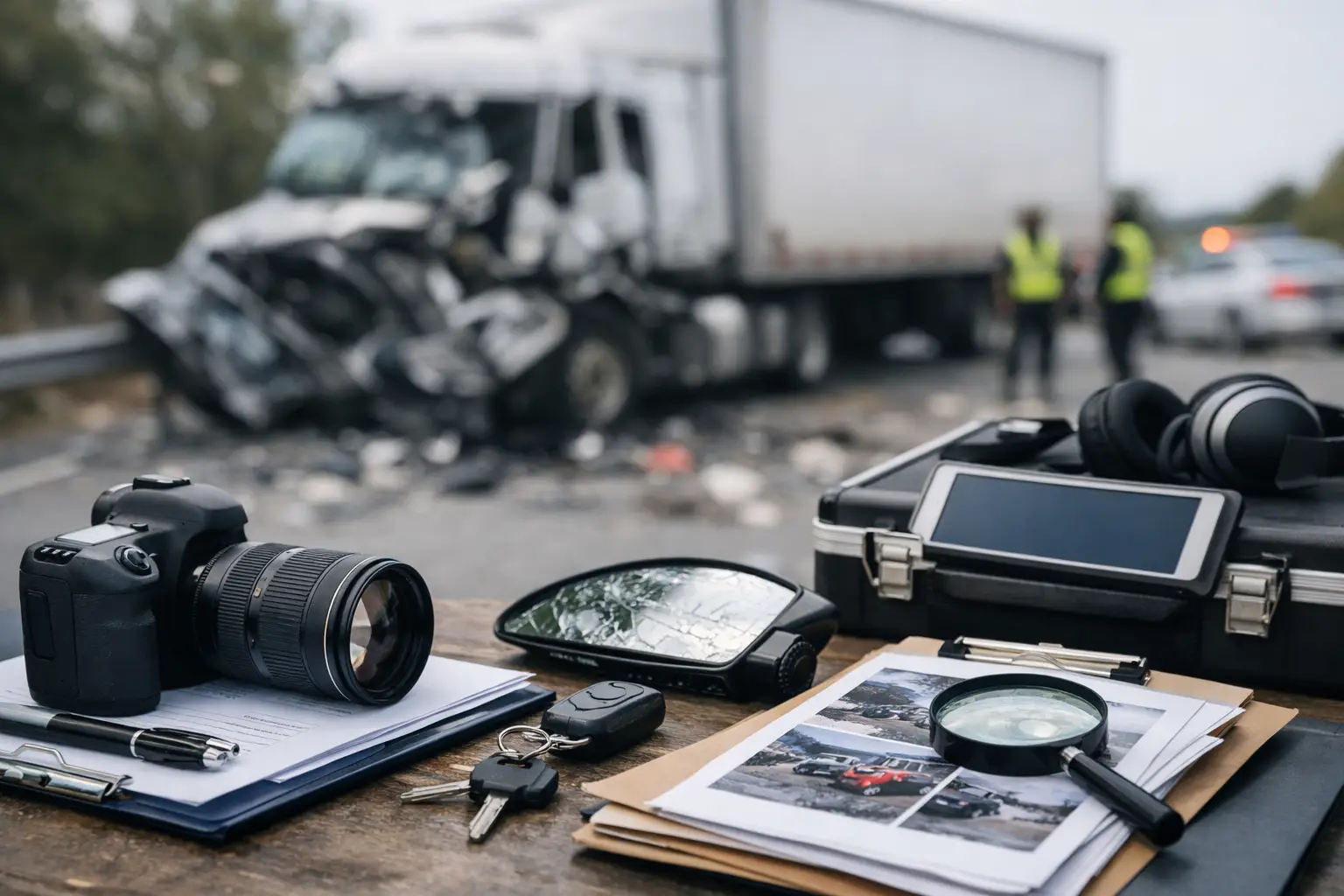

A trucking company can send investigators to a crash scene within hours. That is the reality injured people are up against. While you are dealing with pain, medical treatment, missed work, and calls from insurers, the other side may already be working to control the story. That is why truck accident evidence matters so much from the very beginning.
In a serious truck wreck, the key facts are not always obvious from the police report alone. A commercial crash can involve the driver, the trucking company, a cargo loader, a maintenance contractor, a vehicle manufacturer, or more than one insurer. The evidence has to show not only what happened, but also why it happened, who had control, and what rules may have been broken.
Why truck accident evidence disappears fast
Unlike many ordinary car crashes, trucking cases often involve records that are actively managed by a business. Some material is kept in the normal course of operations. Some is overwritten by electronic systems. Some may never be handed over unless a lawyer demands it properly and early.
That timing issue matters. Driver log data, dispatch communications, onboard electronic information, maintenance records, inspection reports, and internal company files can tell a very different story than what appears at the roadside. If those records are lost, deleted, or altered before they are preserved, proving the full truth becomes harder.
Texas cases also move on evidence, not assumptions. If a truck driver says a passenger vehicle cut him off, that claim has to be tested against physical damage, electronic data, witness statements, video footage, and the vehicle’s movement before impact. Serious claims are built with proof, not guesses.
The most important truck accident evidence in a serious case
Every wreck is different, so there is no single checklist that fits every claim. Still, some categories of evidence show up again and again in high-value trucking litigation.
The crash scene itself
Photos of vehicle damage, gouge marks, debris fields, skid marks, road conditions, weather, lane positions, and nearby traffic controls can help reconstruct what happened. The scene may also reveal whether the truck was speeding, braking late, drifting, or making an unsafe turn.
This evidence is strongest when captured early. Roads get cleared. Vehicles get moved. Debris disappears. What seems minor in the moment can become critical later.
Electronic data from the truck
Many commercial trucks carry event data recorders and other onboard systems that capture speed, braking, throttle use, hard stops, and sometimes hours-of-service information. Depending on the truck and fleet, there may also be GPS records, telematics data, inward or outward-facing camera footage, and dispatch tracking.
This can be some of the most powerful truck accident evidence in the case because it may show what the truck was doing in the seconds and minutes before impact. But access is not automatic. The trucking company controls much of it unless legal action forces preservation and production.
Driver logs and hours-of-service records
Fatigue is a major issue in commercial trucking. Federal and state safety rules limit driving hours and require rest breaks. If a driver exceeded allowable hours, falsified logs, or was pushed to keep driving despite exhaustion, that can strongly support negligence.
The challenge is that paper logs, electronic logging device data, fuel receipts, toll records, weigh station records, and dispatch messages may need to be compared to see if the timeline makes sense. A driver log by itself is not always the full picture.
Driver qualification and company hiring records
A trucking company has duties beyond putting a driver behind the wheel. It may be liable for negligent hiring, training, supervision, or retention if it kept an unsafe driver on the road. Prior crashes, failed drug tests, medical issues, license problems, or repeated safety violations may all become relevant depending on the facts.
These records can show whether the crash was not just a driver mistake, but a company failure.
Inspection, maintenance, and repair records
Brakes, tires, lights, steering components, underride guards, and trailer connections all matter in a heavy truck case. If a truck was poorly maintained or put into service with known defects, that can shift the case in a significant way.
Sometimes the issue is not driver fatigue or distraction at all. Sometimes the problem is a blown tire, brake failure, or a trailer issue that should have been caught before the truck ever left the yard. Maintenance records help answer that question.
Cargo and loading records
Improper loading can make a truck unstable, increase stopping distance, or cause a rollover or jackknife. Overweight loads, uneven weight distribution, unsecured cargo, and shifting freight can all contribute to catastrophic wrecks.
In those cases, liability may extend beyond the trucking company. A shipper, broker, or loading contractor may have played a role, which is why bills of lading, loading instructions, weight tickets, and cargo securement records can matter.
What injured people should do right away
The first priority is medical care. Get evaluated and follow treatment instructions. Serious injuries do not always show their full extent at the scene, especially after a high-force collision with an 18-wheeler.
If you are physically able, document what you can. Take photos of your vehicle, visible injuries, the truck, the trailer markings, license plates, and the surrounding area. Get names and contact information for witnesses. Keep the police report information. Preserve damaged personal items.
Just as important, avoid giving detailed recorded statements to the trucking insurer before speaking with a lawyer. Insurance adjusters are not neutral fact finders. Their job is to protect the company and limit payout. In a trucking case, a rushed statement can be used against you before the evidence is fully known.
Why early legal action can change the case
One of the most important steps in a truck crash claim is sending a preservation letter quickly. This puts the company on notice that critical evidence must be kept. Without that step, valuable material may be destroyed under routine record retention practices or overwritten by electronic systems.
A lawyer can also move fast to investigate the scene, inspect the vehicles, work with reconstruction experts, obtain black box data, demand company records, and identify every potentially responsible party. That is not legal theater. It is how strong cases are built.
There is also a practical reason to act early. Trucking companies and their insurers often start developing defenses immediately. They may argue the injured driver caused the wreck, that injuries were preexisting, or that medical treatment was excessive. The longer the delay, the more room they have to shape the narrative.
Common problems with truck accident evidence
Not every case comes with perfect proof. Sometimes a camera was not working. Sometimes witnesses disappear. Sometimes the vehicles are repaired or salvaged before a full inspection. Sometimes the police report gets key facts wrong.
That does not mean the claim is lost. It means the case requires a serious investigation. Strong lawyers know how to piece together evidence from multiple sources and test whether the trucking company’s version actually holds up.
It also depends on the type of crash. A rear-end collision may point strongly toward truck driver negligence, but not always. A wide-turn crash, underride crash, rollover, tire failure, or multi-vehicle pileup can raise more complicated liability questions. The evidence has to be matched to the mechanics of the wreck.
How truck accident evidence affects compensation
Evidence is not only about fault. It also affects damages. Medical records, imaging, treatment recommendations, wage loss records, and testimony from doctors, family members, and vocational experts may all be needed to show the true cost of the crash.
In catastrophic injury cases, the defense often fights hard on future damages. They may admit some responsibility but challenge whether the injuries are permanent, whether future care is necessary, or whether the victim can return to work. The stronger the evidence, the harder it is for them to minimize what the crash has taken.
That is especially true in fatal trucking cases. Wrongful death claims require proof not just of how the wreck happened, but of the financial and human loss suffered by the family.
When to call a truck accident lawyer
If a commercial truck was involved and anyone was seriously hurt, the answer is usually immediately. The bigger the crash, the more likely it is that critical evidence exists outside your control and may not remain available for long.
The Buchanan Law Office, P.C. handles serious injury cases with that urgency in mind. Trucking companies build their defenses early. Injured people should have someone protecting their side just as fast.
After a truck crash, waiting rarely helps. The right evidence can prove fault, expose safety violations, and show the full value of the harm done. The sooner that evidence is protected, the better your chance of forcing accountability when it matters most.









One Comment